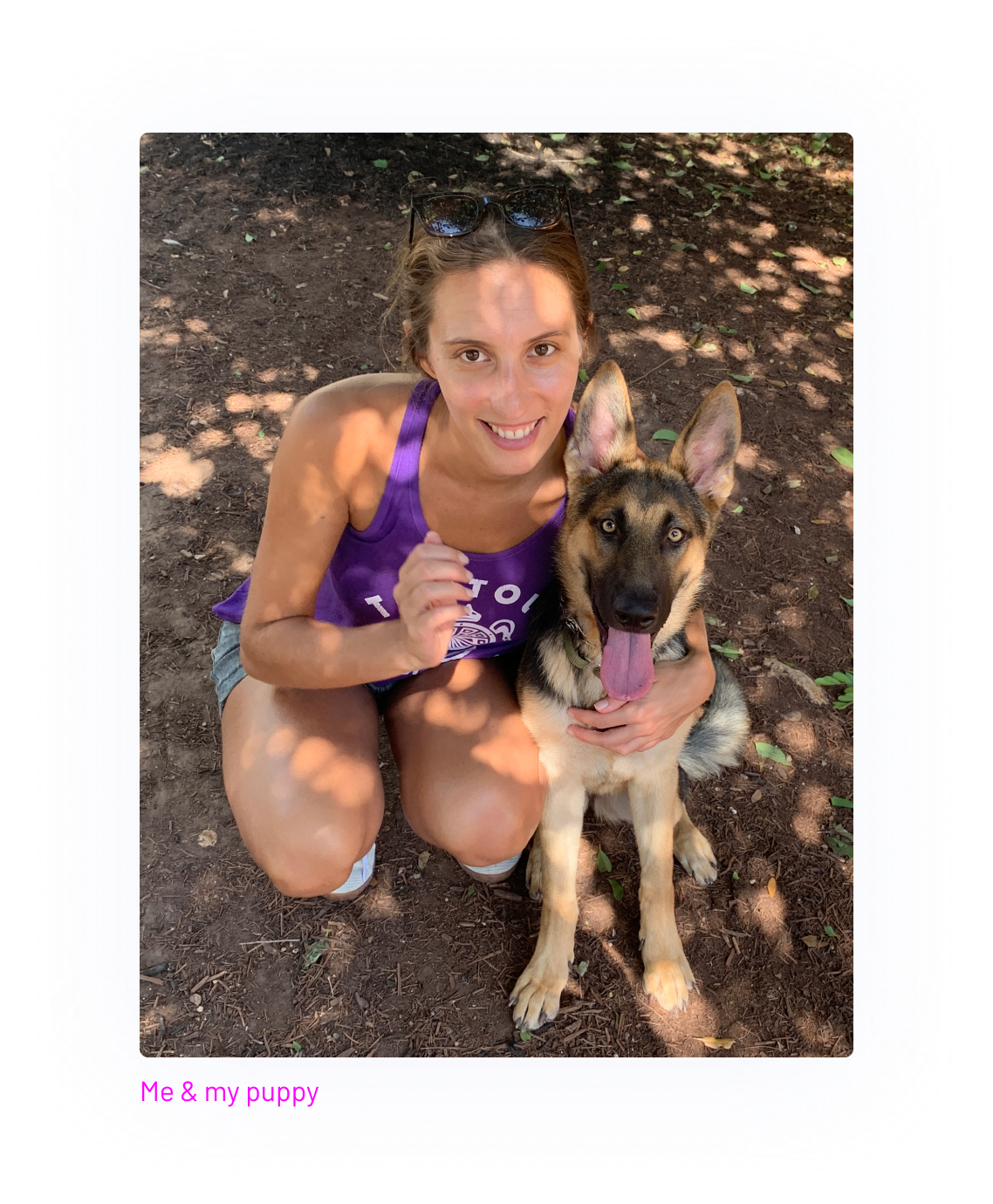
i'm emma

UX Lead from France, living in Austin, TX โ€” currently open to new opportunities.

Once a teacher, I now combine the know-how of engaging people while transforming intricate ideas into smooth and approachable experiences. 4+ years leading UX at Bloom Growth, supporting 10,000+ users.

See workโ†“
Emmanuelle Berda
๐Ÿ‡ซ๐Ÿ‡ท
I am originally from France.
I experienced and absorbed various cultures, beliefs, and customs.
โœˆ๏ธ
I spent 15 years abroad.
Being in Congo, Argentina and El Salvador is a gift that I wish to share.
๐ŸŒ
I have a multicultural perspective.
Being abroad for half my life taught me to be aware of the subtleties of many cultures and attentive to people's motivations.
๐ŸŽ“
My education has given me a unique insight.
I studied at UCLA where I received a BA in Global Studies and French Literature, followed by a teaching credential.
๐Ÿค 
I moved to Austin in 2018.
Being in an emerging tech hub, I decided to officially start my UX design journey with Lambda School.
๐Ÿคฟ
I love exploring nature in my spare time.
I like hiking, scuba diving (sometimes with sharks!), eating sweet potato fries, watching documentaries and much more.
See the live product at bloomgrowth.com โ†’
01 / 04
Continuous DiscoveryResearch Ops

Building a continuous user feedback loop from scratch

At Bloom Growth, user feedback was scattered and reactive. I designed an end-to-end discovery system so the team could talk to users regularly, capture insights consistently, and act on patterns โ€” not one-off complaints.

Real example โ€” KPI color coding in the metrics section
In the metrics section, users were tracking KPIs but struggling to quickly read performance at a glance. We introduced color coding to the data cells: the closer a value was to its goal, the greener it appeared โ€” the further away, the redder. This let users instantly spot trends across weeks without reading every number. It was a quick win โ€” and we knew it was working because our in-app feedback modal lit up with positive responses. We rolled it out to a small user group first to catch any flaws, then scaled once we were confident. The feedback loop made that staged launch possible.
See the live product โ†’
Problem
  • No structured collection process
  • Insights stayed siloed
  • Product decisions were gut-driven
What I did
  • Auto-scheduling via HubSpot post-meeting
  • Weekly tagged readouts in ClickUp
  • Sentiment scores for leadership
  • Rotating dev in feedback reviews
02 / 04
CollaborationAgile

Sharpening tickets: bringing UX into story writing

Developers were building the wrong things โ€” not bad intent, but vague tickets and undefined success criteria. I introduced a layered approach that balanced specificity with shipping velocity.

Real example โ€” jobs to be done in user stories
Instead of writing "add a meeting button to the nav," we'd reframe it as: "As a team leader, I need to schedule a recurring meeting so that my team stays aligned every week." That shift changes everything โ€” suddenly the question isn't where the button goes, but whether scheduling should even live in the nav at all. Jobs-to-be-done kept us focused on the outcome, not the solution.
Real example โ€” the metric chart that did the wrong thing
We had a metrics chart with an arrow the developer assumed meant "expand to see all data" โ€” so as more data came in, the chart shrank to fit it all. But the intended behavior was for the view to shift quarter by quarter, not compress. Nobody caught it until QA because the ticket had no success criteria. There was no definition of what "correct" looked like. After that, every chart story included an explicit expected behavior: what the user sees, when, and what changes on interaction.
See the live product โ†’
Challenge
  • Tickets had no success criteria
  • Scope creep was rampant
  • UX vision invisible in dev work
Approach
  • Lasagna layers: ship small, refine
  • Pain point snapshots in tickets
  • Problem-first framing in grooming
  • Crazy 8s for team brainstorming
03 / 04
Data-driven designUsability

Using PostHog to make design decisions with real usage data

We had hypotheses about how users navigated the product โ€” but not proof. I set up a usability testing framework and layered in PostHog analytics to validate decisions and measure impact.

Real example โ€” the "add meeting" button
Users weren't adding meetings โ€” and data showed why. The "+" button in the nav was being misread as a dropdown toggle, not an action. Interviews confirmed it: people kept clicking expecting a menu to open. We also realized most users don't create meetings often โ€” leadership sets them up once at the start of a quarter. The "+" was creating visual noise for something that barely happened. My proposed fix: move it behind the meetings panel, so adding a meeting happens in context rather than polluting the nav.
See the live product โ†’
โ‰ค3Clicks, core flows
โ†‘Feature adoption
What I tracked
  • Click counts on all core functions
  • Drawer usage patterns
  • User paths before key actions
Impact
  • Found underused vs unneeded features
  • Grounded priorities in behavior
  • Before/after design comparisons
04 / 04
Cross-functional influenceAdvocacy

Making the invisible visible: sharing user pain with dev teams

A persistent scroll issue kept frustrating users at every meeting but stayed deprioritized. I turned interview clips into an empathy tool that finally moved the whole team to act.

Real example โ€” a clip that changed the room
During grooming, we embedded a short clip of a user struggling to scroll through the meeting agenda โ€” visibly frustrated, losing their place mid-session. We attached it directly to the ticket. The moment it played, the energy in the room shifted. Developers who had been skeptical about prioritizing it suddenly got it. Even the PM, who had been hesitant, felt it. No amount of data points would have done what thirty seconds of real user frustration did. It's a reminder that working closely with developers isn't just about writing better tickets โ€” it's about building the kind of shared empathy that makes good decisions feel obvious.
See the live product โ†’
The situation
  • Users complained at every session
  • Devs didn't feel the urgency
  • Tickets weren't cutting through
What shifted it
  • Shared interview clips in standups
  • Embedded pain clips in Figma
  • Rotating dev in feedback reviews
UX Lead
Bloom Growth (formerly Meetings.io & Traction Tools)
Feb 2022 โ€“ Jul 2025 ยท Remote
  • Promoted from UX Designer to UX Lead within the same company through rebrands
  • Led UX vision and strategy across the platform, supporting 10,000+ users
  • Managed and mentored distributed design team; built and maintained design system
  • Worked closely with product and engineering to define a streamlined roadmap
  • Built continuous discovery loop: feedback tagging, weekly readouts, sentiment scoring
  • Introduced jobs-to-be-done framing and success criteria to improve ticket quality
  • Used PostHog analytics to validate design decisions and measure feature impact
UX Designer
Meetings.io (now Bloom Growth)
Jun 2021 โ€“ Feb 2022 ยท Remote
  • Led first UX/UI establishment process and product design language
  • Built Figma component library and handoff docs; promoted to UX Lead upon rebrand
Product Designer
Freelance
Sep 2020 โ€“ Present ยท Remote
  • Redesigned B2B & B2C flows for Saak Clinical, LivePortis, NobleMoney
  • Conducted user research and maintained visual/brand consistency across clients
UX Designer
BioBid
May 2020 ยท Remote
  • Led full UX process from competitive analysis to final prototype
  • Created consistent visual style guide and design system
01
Start with the user, not the solution
I stay close to what users actually do and feel โ€” through interviews, feedback loops, and behavioral data โ€” before any design decision is made.
02
Ship small, learn fast
I use layered user stories to keep scope tight and velocity high. A clear, narrow feature in front of users is worth more than a perfect one on a roadmap.
03
Make data a shared language
From click counts to sentiment scores, I translate usage data into something the whole team โ€” designers, developers, leadership โ€” can act on together.
04
Build empathy across the team
I bring user voices directly into standups, tickets, and Figma files. When developers feel what users feel, the right decisions get made faster.

AI changed the process.
It didn't replace the designer.

Tools move faster than ever. But speed without judgment creates noise, not clarity. The role of a designer has shifted โ€” and become more essential. Someone still has to connect all the dots.

๐Ÿ”—
Connect the dots
Someone needs to bridge user preferences with design decisions โ€” reading between the data and making the call that serves real people.
๐Ÿ“Š
Find the signal in the data
Someone needs to gather and interpret feedback, spot trends and pitfalls, and turn raw numbers into a direction the whole team can follow.
๐ŸŽฏ
Decide what matters
Someone needs to prioritize ruthlessly โ€” knowing what to build now, what to defer, and how to make that case clearly to stakeholders and developers.
๐Ÿค
Negotiate with the team
Someone needs to hold the line on user needs in grooming sessions, push back on scope creep, and keep the product moving without losing quality.
๐Ÿ”„
Build the feedback loop
Someone needs to set up the system โ€” the recurring interviews, the tagging, the analysis, the readouts โ€” so learning never stops between releases.
โœฆ
Protect craft and quality
Someone needs to ensure that shipping fast doesn't mean shipping rough โ€” keeping the experience coherent, accessible, and genuinely usable.
๐ŸŽ™
Talk to users
Someone needs to sit across from a real person, listen without leading, and bring that empathy back into every decision the product team makes.
โš™๏ธ
Set it all up
Someone needs to build the infrastructure โ€” the tools, the processes, the habits โ€” that make great UX repeatable, not accidental.
UX Design
Lambda School
2019 โ€“ 2020 ยท Austin, TX
Teaching Credential
California State University
2014 โ€“ 2016 ยท Los Angeles, CA
BA, Global Studies & French Literature
UCLA
2009 โ€“ 2013 ยท Los Angeles, CA